
Does the Fire Safety Order apply to my HMO?
The Regulatory Reform (Fire Safety) Order 2005 does not cover the inside of private dwellings, but it does cover the common parts of HMOs, such as shared hallways, landings and stairs. Since 16 May 2022, it also expressly covers the structure, external walls and flat entrance doors of buildings containing two or more homes. The local fire and rescue authority enforces the Order, and the council can also act on fire hazards under the Housing Act 2004.
There is a nuance. Warwickshire Fire and Rescue Service, for example, says the Order applies to HMO common parts but not to 'shared houses', meaning a whole house let to one group, such as sharers on a single joint tenancy. That does not make fire safety optional: the council's housing standards still apply, and a written assessment is the clearest way to show the risks have been thought through. We tell you how your house is likely to be treated and assess it either way.
Who is the responsible person, and what must they do?
Where the Order applies, the responsible person is usually the landlord or the managing agent: in practice, whoever controls the shared parts of the house. They must carry out a fire risk assessment, keep it up to date and put in place the precautions it identifies. Where an agent is involved, the management agreement should say clearly who does what.
The Management of HMOs (England) Regulations 2006 add duties that overlap with fire safety in every HMO, licensed or not. The manager must:
- keep escape routes clear and in good repair
- maintain fire-fighting equipment and fire alarms
- display fire escape notices where there are more than 4 occupiers
If you own the house but someone else manages it, you still need to know that the assessment exists and that its actions are being done. We give you a copy to keep, and we review it whenever the house, the occupiers or the way it is managed changes. Our guide to HMO management duties covers the wider regulations.
What does an HMO fire risk assessment look at?
We work from the Home Office guide for sleeping accommodation and the LACORS housing fire safety guidance, which councils widely use as their benchmark for existing HMOs. Both are risk-based: LACORS describes itself as setting no prescriptive requirements. The assessment covers:
- escape routes from every bedroom to a final exit, including inner rooms and locks on exit doors
- fire doors, self-closers, gaps and damage, and fire separation in walls, ceilings and under stairs
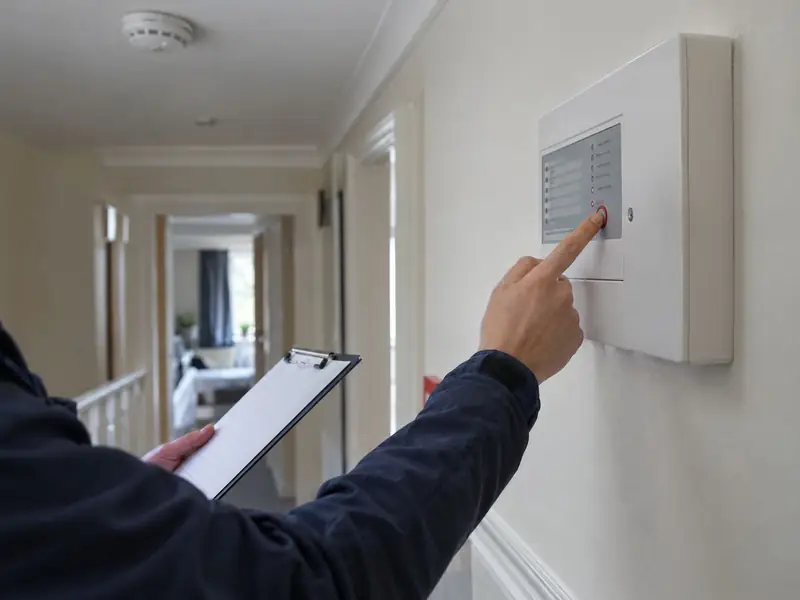
- the detection and alarm system, and how it is tested
- emergency lighting, signs and fire-fighting equipment
- ignition sources such as cooking, heaters, electrics and smoking
- storage and rubbish in shared areas
- the people at risk, including anyone who may need help to escape
Fire doors (typically FD30 or FD30S with self-closers) and a mains-wired interlinked alarm system are commonly required, depending on the property's layout, size and fire risk assessment, and the local council's HMO standards. In a lower-risk house with sound construction, LACORS may accept good-quality, close-fitting, self-closing solid doors instead.
What is in the action plan, and when is it reviewed?
Each finding in the report is matched to an action, a priority and a reason. We separate the items that affect whether people can escape safely now, such as a missing self-closer or a blocked exit, from improvements that can be planned. That lets you budget and programme the work rather than guess.
The duty is to keep the assessment up to date, not to file it and forget it. We recommend a review:
- at least once a year
- after building work, a new layout or extra bedrooms
- after a fire, repeated false alarms or damage to doors or detectors
- when an occupier may need help to get out in an emergency
- before a licence application or renewal
If the action plan calls for works, our HMO fire safety works team can price and carry them out, and the review then records what has been done. Our guide to HMO fire safety explains the wider rules.
What's included
- Site visit covering common parts and every escape route
- Written fire risk assessment report for you to keep
- Prioritised action plan with a reason for each item
- Check of fire doors, alarms and emergency lighting
- Advice on the responsible person's ongoing duties
- Reviews after building work, layout or occupancy changes
What does it cost?
We quote for fire risk assessments per property. The price depends mainly on:
- the number of storeys, bedrooms and shared areas
- how complex the escape routes are, for example inner rooms, basements or loft rooms
- whether this is a first assessment or a review of one we wrote
- whether you need the report for a licence application by a set date
Any fire safety works the report identifies are quoted separately, after you have seen the action plan. Council fees are separate too: licence fees are set by each council, planning application fees are fixed under the planning fee rules, and both are paid to the council, not to us. Ask for a quote with the address and number of rooms.