
Which licence does my HMO need?
There are three kinds of licence, and the address decides which applies.
- Mandatory licensing covers any HMO with 5 or more occupiers forming 2 or more households. It applies everywhere in England.
- Additional licensing lets a council bring smaller HMOs, such as a house shared by 3 or 4 people, into licensing in all or part of its area.
- Selective licensing covers other privately rented homes in areas the council has designated.
Since 23 December 2024, councils can make additional and selective schemes of any size without the Secretary of State's approval, although they must still consult. Schemes start, change and end, so a check made last year may be out of date. Our HMO licensing checker gives a first view, and we confirm the position for the exact street before we prepare anything. For background on each scheme, read HMO licensing explained.
What goes into an HMO licence application?
Councils use their own forms, but the evidence they ask for is broadly similar. We commonly prepare:
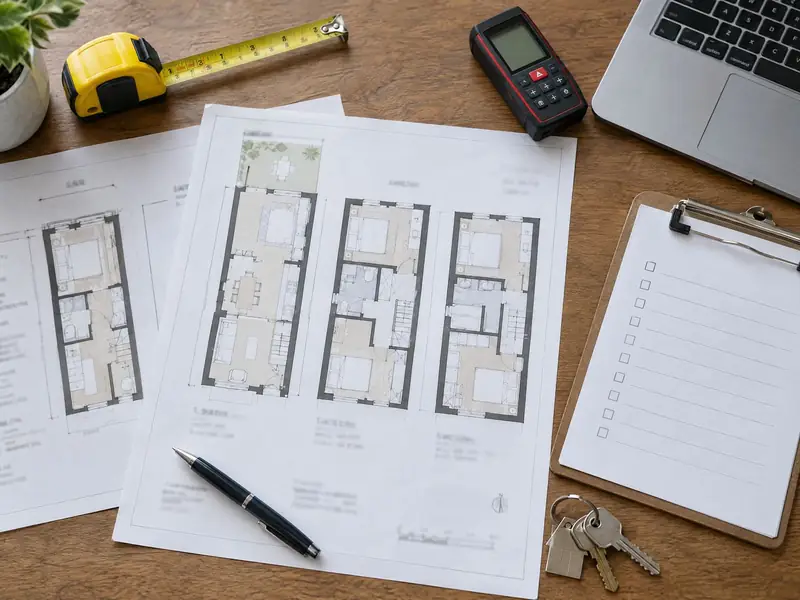
- a floor plan showing room sizes, room use, fire doors, alarms, escape routes and amenities
- a current gas safety record and electrical installation condition report (EICR)
- fire alarm and emergency lighting certificates, and a fire risk assessment
- details of the proposed licence holder and manager, with contact addresses
- fit and proper declarations for the people named on the application
The fit and proper test looks at matters such as offences involving fraud, dishonesty, violence or drugs, certain sexual offences, unlawful discrimination and breaches of housing or landlord and tenant law. Anyone subject to a banning order cannot pass it. We help you decide who should be named as licence holder and manager, but the declarations are yours to make, and they must be honest.
What happens after the application goes in?
The council reviews the application and may inspect the house, either before or after it decides. It usually then sends a draft licence, sometimes called a notice of proposal, setting out the conditions it intends to attach and giving a period for comments. Every HMO licence must carry the national room-size conditions: 6.51 m² for one person over 10, 10.22 m² for two people over 10 and 4.64 m² for a child under 10, with floor area under a ceiling lower than 1.5 m left out. Councils often add their own conditions on amenities, fire safety and management.
We read the draft against the house as it stands. If a condition is unclear, does not match the property or sets a deadline you cannot meet, we help you respond within the time the council allows. If works are needed, we can price and carry them out. A licence lasts no more than 5 years, and the council may set a shorter term.
Why does getting the licence right matter?
The penalties for licensing failures increased on 1 May 2026. Controlling or managing a licensable HMO without a licence can lead to:
- a civil penalty of up to £40,000
- a rent repayment order of up to 2 years' rent, which tenants or the council can apply for within 2 years of the offence
Breaching licence conditions is a separate offence, also with a civil penalty of up to £40,000. Since 1 May 2026, the licensing offence can be committed by anyone who controls or manages the house and by a superior landlord further up the chain, such as an owner who has let the house to a rent-to-rent company. A superior landlord has a defence if they did not know, and had no reason to know, that the property was an HMO, or if they took all reasonably practicable steps. Rent repayment orders can also be made against superior landlords and, in some cases, company directors. If you are unsure whether a house needs a licence, ask before letting rooms, not after.
Do I need a new application to renew or change a licence?
Licences end on a fixed date, and in most cases a renewal is a fresh application with up-to-date evidence. Councils do not always send reminders, so we note the expiry date and start gathering certificates and plans well before it. A licence is granted to a named licence holder, so a new owner usually needs to apply in their own name.
Changes during the licence may need a variation. Common examples are a new manager, a change in the number of occupiers or households, or building work that alters the layout, such as an extra bedroom. Adding rooms without telling the council can breach the licence's occupancy limits. We prepare the variation request with revised plans and certificates, and coordinate it with any planning or building control approval the work needs. Our HMO floor plans service covers updated drawings, and a compliance audit is a sensible check before a renewal.
What's included
- Check of mandatory, additional and selective licensing at the address
- Council application form completed and checked
- Measured floor plan in the council's usual format
- Gas, electrical, alarm and lighting certificates collated
- Licence holder, manager and fit and proper details prepared
- Help with draft conditions, renewals and variations
What does it cost?
We quote for licence applications per property, after we have seen the house and confirmed which scheme applies. The main things that affect our price are:
- the size of the house and the number of floors and rooms to plan
- whether a current floor plan and certificates already exist, or need producing
- how much detail the council's form and standards ask for
- whether the application is new, a renewal or a variation
The council's licence fee is not part of our price. Each council sets its own licence fee, and it is paid to the council, not to us. If the work also needs planning permission, the planning application fee is fixed under the planning fee rules and is likewise paid to the council. Request a quote or contact us with the address.